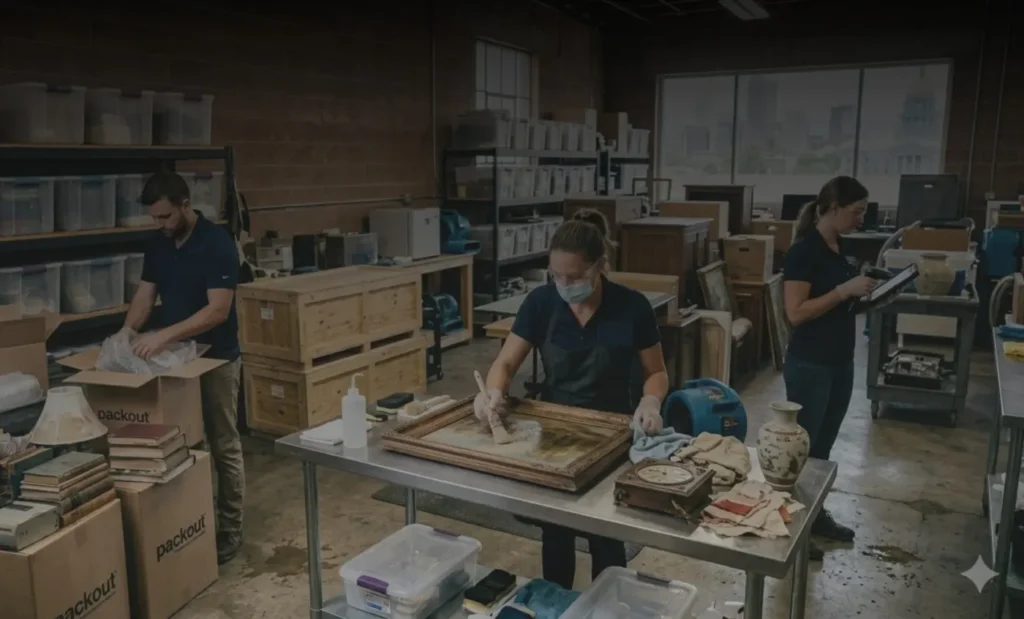
Every restoration contractor has had the job where the drying plan is ready and the room is still full of someone’s life. Dressers, a piano, forty boxes of holiday decorations, and a homeowner asking who is responsible for all of it.
Contents can stall a job faster than almost anything else. This guide covers when to bring in a contents partner, what that partner should handle, and how to set up a clean handoff.
Why contents slow restoration jobs down
Structural work needs access. Drywall, flooring and cabinets can’t come out while furniture sits in the way.
Moving belongings yourself pulls crews off structural work. It also puts your company on the hook for anything scratched, lost or missing from the inventory.
Then there’s the paperwork. Adjusters want to know what was in each room, its condition and where it went, and field crews rarely have time to record all of that.
When to bring in a contents partner
Not every loss needs one. A wet closet in one bedroom can usually be handled by moving things to another room.
A contents partner makes sense when:
- Demolition or flooring removal will touch most of a room or floor
- Smoke or soot has reached belongings beyond the room where the fire started
- The home will be unlivable during repairs
- The homeowner has artwork, antiques, instruments or other high-value items
- The job is commercial, multi-unit or simply too large to track by hand
Contents are part of the industry standard, too. The ANSI/IICRC S500 standard for water damage restoration lists contents evaluation, restoration and remediation as its own component, next to structural restoration and drying.
Call early. Belongings sitting in a wet or smoky room keep taking damage while the scope gets written.
What a contents partner should handle
Inventory and documentation
Every item should be photographed and logged by room before it moves. Barcoding lets each piece be traced through cleaning, storage and return.
That record has to hold up to an adjuster’s review. Here is what goes into a contents inventory Denver adjusters actually accept.
Pack-out and transport
Professional contents pack-out services wrap, crate and remove belongings so your crew starts with empty rooms. Fragile and high-value pieces get extra protection.
Cleaning and restoration
Salvageable items need cleaning matched to the damage, whether that’s soot, water or mold. A good partner separates restorable items from total losses and documents both.
Homeowners often ask what can and cannot be restored after fire or water damage. A partner who answers that question saves your project manager the conversation.
Storage
Belongings need somewhere stable to wait while the structure is rebuilt. Climate-controlled contents storage that manages humidity as well as temperature protects wood, electronics, photos and textiles.
Pack-back
When your work is done, contents come back and go into the right rooms. Delivery and pack-back should be scheduled around your final punch list, never ahead of it.
How to make the partnership work
Agree on who makes the call
Decide upfront whether you call the contents partner or the homeowner does. Either works, as long as nobody assumes the other person did it.
Share the schedule
The contents team needs to know when demo starts and when rooms will be ready again. A shared timeline keeps furniture from arriving before the paint is dry.
Keep one inventory
The contents inventory should be the single record for the claim. Point the adjuster and homeowner to it rather than starting separate lists.
It also gives your project manager one place to look when the homeowner asks where the dining chairs went.
Raise the insurance side early
Pack-out, cleaning and storage are often handled under the contents portion of the claim, separate from the structural estimate. Policies vary, so the homeowner should confirm with the adjuster and read up on how insurance handles contents claims.
What to look for in a contents partner
- IICRC-certified technicians
- Item-level inventory with photos and barcodes
- Storage that controls humidity, not only temperature
- Experience working directly with adjusters
- 24/7 availability for emergency losses
- A clear process for commercial and multi-unit jobs
Ask to see a sample inventory report. It tells you more about a company than any sales pitch.
Keep crews on the structure
A contents partner brought in early keeps your crews on structural work and keeps the claim documented. Homeowners also tend to stay calmer when they know exactly where their belongings are.
ContentsPros Denver works alongside restoration contractors across the Denver metro on pack-out, cleaning, climate-controlled storage and pack-back for fire, water and mold losses. Call (303) 335-0125, any time of day, or request service online to set up a contents partnership before your next job.